Wildlife in Norway: Where and When to See Norway’s Most Iconic Animals
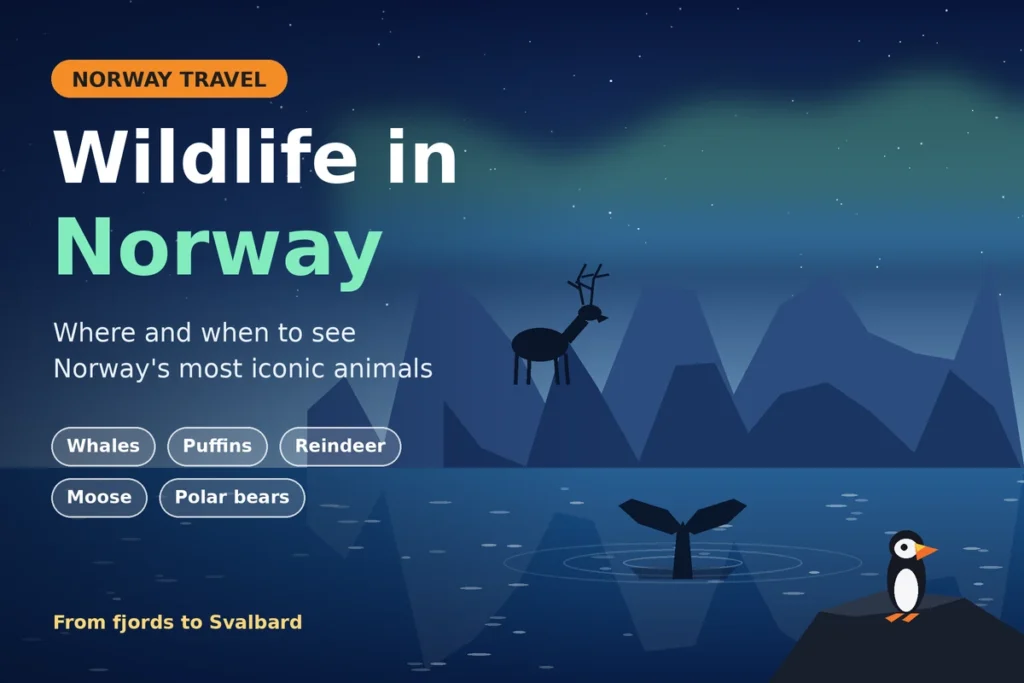
Norway is home to whales, reindeer, puffins, moose, and Arctic foxes. Its mountains, forests, islands, and fjords provide habitats for many fascinating animals. You can spot some species from the coast, while others require a guided wildlife trip.
The best time to visit depends on the animals you want to see. Summer is excellent for seabirds and hiking. Winter offers opportunities to see orcas and humpback whales in northern waters. Svalbard is a special destination for Arctic wildlife.
Whale Watching in Norway
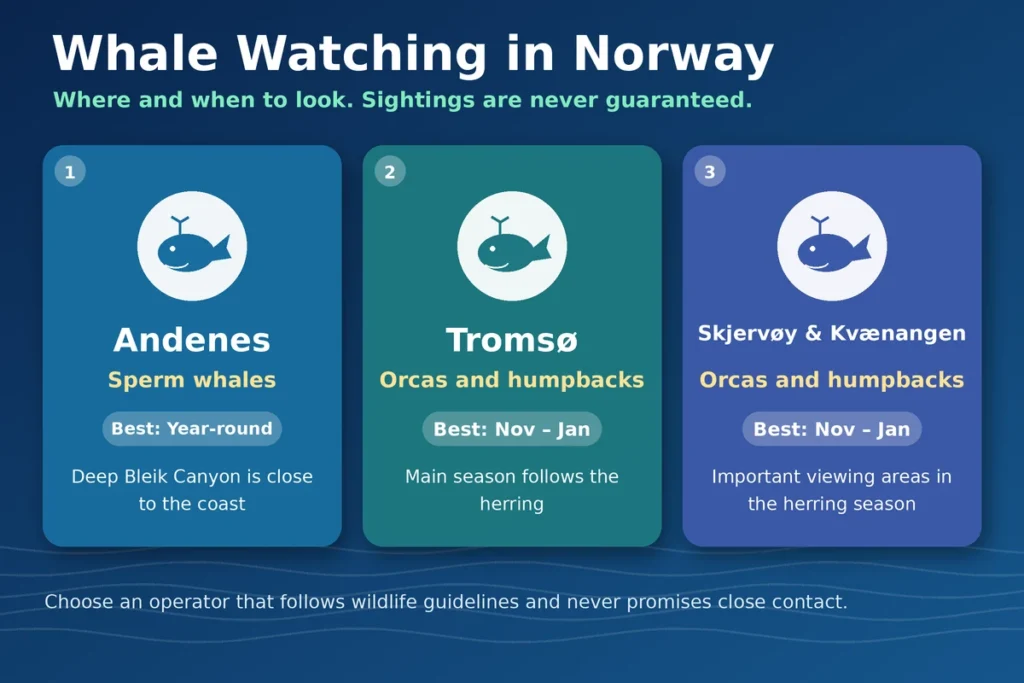
Whale watching is one of the most exciting ways to experience wildlife in Norway. Northern coastal waters attract several whale species. Andenes is known for sperm whales, while the fjords around Skjervøy and Tromsø can attract orcas and humpback whales during the herring season. Sightings depend on natural conditions.
Which Whale Species Can You See in Norway?
You may see sperm whales, orcas, humpback whales, minke whales, and pilot whales. Harbour porpoises also live in Norwegian waters. Different species appear in different places and seasons, so research your destination before booking.
Whale Watching in Andenes
Andenes lies on Andøya in the Vesterålen archipelago. Deep ocean waters are close to the coast, making the area a popular place to search for sperm whales. Local operators offer boat trips with guides who explain whale behaviour and marine life.
Why Andenes Is So Good for Whale Watching
The nearby Bleik Canyon has deep waters that attract sperm whales. This makes whale watching possible throughout the year. You may also see seabirds, seals, and other marine animals during your trip.
Best Time to Visit Andenes
Summer is a popular season for whale watching in the Andenes. Sperm whales can be seen year-round, although sightings are never guaranteed. Winter trips may offer opportunities to see other species, depending on local conditions.
Recommended Whale Watching Tours
Look for established operators such as Whalesafari Andenes and Sea Safari Andenes. Compare trip length, boat type, age restrictions, and cancellation policies. Check the latest departure information before booking.
Multi-Day Orca Expeditions
Multi-day trips can provide more time to explore northern waters. Some focus on orcas and humpback whales during the winter herring season. Choose a responsible operator that follows wildlife guidelines and never promises guaranteed sightings.
Orcas and Humpback Whales Near Tromsø
The waters north of Tromsø can attract orcas and humpback whales when herring gathers in the region. Skjervøy and Kvænangen are important viewing areas. Many excursions leave Tromsø and travel by road before joining a boat trip.
Best Time
The main whale-watching season around Tromsø often runs from November to January. Exact timing changes with the movement of herring and whales. Check local reports before arranging your trip.
Best Locations
Tromsø, Skjervøy, and Kvænangen are popular starting points. Some tours depart directly from Tromsø. Others include transport to Skjervøy for a boat excursion.
Recommended Operators
Check the providers listed by Visit Tromsø and compare their itineraries. Look for clear safety rules, experienced guides, and responsible whale-watching practices. Avoid operators that promise close contact with wild whales.
Relevant Reading
Before your trip, read local whale-watching guidance and check seasonal updates. You can also explore guides to Tromsø, the Lofoten Islands, and Vesterålen to plan nearby activities.
Puffins and Seabirds
Norway’s coast supports large colonies of seabirds. Puffins are among the most recognisable species, with colourful bills and distinctive black-and-white feathers. You can also see guillemots, razorbills, gannets, and kittiwakes at coastal bird cliffs.
Runde: Norway’s Puffin Capital
Runde is an island off Norway’s western coast. Its steep cliffs provide nesting grounds for puffins and other seabirds. Visitors can follow walking trails to suitable viewing points without approaching nesting birds.
Best Time to Visit
Late spring and summer are generally the best seasons to look for nesting seabirds. Puffins usually spend much of the winter at sea. Check current local information before planning a visit.
Recommended Experiences
Walk the marked trails on Runde or join a local boat trip when available. Bring binoculars and a camera with a zoom lens. Keep away from cliff edges and nesting areas.
Varanger Peninsula: One of Norway’s Greatest Wildlife Destinations
The Varanger Peninsula in northeastern Norway is a major destination for birdwatching. Its Arctic landscape includes rocky coasts, wetlands, and open tundra. Bird species vary by season, making it interesting throughout the year.
Birdwatching
Look for seabirds, eiders, waders, and other northern species. Hornøya, near Vardø, is a notable seabird island. Local bird hides can help you observe birds without disturbing them.
Sea Eagles in Lofoten and Vesterålen
White-tailed sea eagles are impressive birds with broad wings and powerful beaks. They live along much of Norway’s coast, including the Lofoten and Vesterålen islands. You may spot them soaring above the sea or resting on coastal rocks.
Trollfjord: The Best Place to See Sea Eagles
Trollfjord is a narrow fjord in the Lofoten region, surrounded by steep mountains. Boat trips often explore its dramatic scenery. Sea eagles may appear during the journey, but sightings are not guaranteed.
Best Time
Sea eagles can be seen throughout the year. Summer offers long daylight hours and convenient conditions for boat trips. Winter visits may bring quieter scenery and changing weather.
Recommended Tours
Choose a licensed local boat operator and check the route before booking. Responsible tours observe eagles without disturbing them. Avoid any activity that encourages wildlife to approach boats unnaturally.
Musk Oxen om Dovrefjell
Dovrefjell is one of the few places in Europe where you can see musk oxen in the wild. These large animals have thick coats and powerful bodies. Guided walks can improve your chances of finding them in their natural habitat.
One of Europe’s Most Unique Wildlife Experiences
Musk oxen look calm, but they can charge when threatened. They are wild animals, not domestic cattle. Observe them from a safe distance and never try to approach them for a photograph.
Best Time
Musk oxen live on Dovrefjell throughout the year. Summer is popular for hiking and guided wildlife walks. Weather and animal movements can affect sightings.
Recommended Tours
Book a guided musk ox safari with an experienced local provider. Guides understand the terrain and know how to observe the animals safely. Follow their instructions throughout the trip.
Important Safety Information
Keep at least 200 metres away from musk oxen. If one is nearby, move around it in a wide curve rather than walking directly toward it. Never block its escape route.
Reindeer in Norway
Reindeer are closely linked to Norway’s northern landscapes and Sámi culture. Some herds are semi-domesticated and managed by Sámi reindeer herders. Wild reindeer also live in mountain regions. Give all reindeer space and avoid disturbing their movement.
Svalbard Reindeer
Svalbard reindeer are a distinct subspecies adapted to the Arctic environment. They have compact bodies and thick coats. You may see them grazing around Longyearbyen and other parts of the archipelago.
Best Time
Summer often makes wildlife easier to observe because of long daylight hours. Reindeer can be present in other seasons too. Snow and weather may affect access to viewing areas.
Best Location
Look for Svalbard reindeer around Longyearbyen and on guided trips. Keep your distance and never feed them. Their behaviour can change when people get too close.
Semi-Domesticated Reindeer in Northern Norway
Semi-domesticated reindeer are part of reindeer herding traditions in northern Norway. You may see them near roads or open landscapes, especially in areas used for grazing. Their presence varies by season, so sightings are not guaranteed.
Best Time
Reindeer can be encountered in different seasons. Summer travel often provides easier access to northern landscapes. Always respect herding areas and local guidance.
Wild Reindeer
Wild reindeer live in mountain regions such as Dovrefjell. They are shy and may flee when people approach. If you spot a herd, stop at a distance and move away if the animals appear disturbed.
Moose Safaris
Moose are among the largest land mammals in Norway. They live in forests and woodland areas across much of the country. You may spot one while driving or walking, but guided safaris can help you find suitable viewing areas.
Vesterålen
Vesterålen offers more than whale watching. Local operators also arrange moose-watching experiences. Ask about the route, duration, and chances of sightings before booking.
Best Time
Moose may be seen throughout the year. Early morning and evening are often useful times to look for wildlife. Be alert when driving through forested areas, especially around dawn and dusk.
Recommended Experiences
Consider a guided wildlife safari or a visit to an established wildlife attraction. Follow the guide’s instructions and keep a safe distance from free-roaming moose.
Østerdalen: Norway’s Moose Country
Østerdalen is a forested valley in eastern Norway. Its woodland landscape provides suitable habitat for moose. Drive carefully and look for wildlife from safe, permitted viewing areas.
Best Time
Summer and early autumn can be good seasons for exploring the region. Moose sightings remain unpredictable throughout the year. Check local tour availability before travelling.
Best Viewing Times
Early morning and evening can offer good opportunities to spot moose. Stay on marked roads and paths. Never approach a moose or attempt to attract it with food.
Red Deer on the West Coast
Red deer are common in parts of western Norway. They inhabit forests, hillsides, and open areas near the coast. You may see them at the edges of woodland or in fields, particularly during quieter hours.
Best Time
Red deer can be observed in several seasons. Autumn is notable for the rut, when males compete for access to females. Keep your distance and avoid approaching animals during this period.
Recommended Experiences
Explore rural landscapes on foot or join a local nature tour. Use binoculars to observe deer from far away. Avoid entering private land without permission.
Polar Bears on Svalbard
Svalbard is the only part of Norway where polar bears live in the wild. These powerful predators roam across the archipelago and surrounding Arctic environment. Seeing one is possible, but no trip can guarantee a sighting.
Walrus on Svalbard
Walruses are large marine mammals with long tusks and thick whiskers. They often rest in groups on beaches or ice. Svalbard offers opportunities to observe them during suitable coastal or boat excursions.
Best Places
Walruses may be found around parts of Svalbard’s coast. Their locations change, so ask local guides about recent observations. Landing rules apply in protected areas.
Best Time
Summer expeditions can provide opportunities to observe walruses from boats or approved landing sites. Sightings depend on local conditions and animal movements.
Best Way to See Them
Choose a responsible wildlife cruise or guided expedition. Keep well away from resting groups and follow all instructions. Never approach or disturb walruses to get a better photograph.
Norway’s Hardest Animals to Spot
Some Norwegian mammals are difficult to see because they live in remote habitats or avoid people. You may need patience, local knowledge, and a little luck. These animals are not guaranteed sightings on ordinary sightseeing trips.
Lynx
The Eurasian lynx is a secretive wild cat found in parts of Norway. It usually avoids people and moves quietly through suitable habitats. Most visitors are unlikely to spot one in the wild.
Wolverine
Wolverines live in remote mountain and forest regions. They have strong bodies and are well adapted to cold climates. Sightings are rare, so look for signs of wildlife only with a knowledgeable guide.
Brown Bear
Brown bears occur in parts of mainland Norway, particularly in some border regions. They generally avoid people but remain wild predators. Make noise while hiking in suitable bear areas and never approach a bear.
Wolf
Wolves live in limited areas of southeastern Norway, especially near the Swedish border. They are elusive and rarely seen by visitors. Respect wildlife signs and do not attempt to track or approach them.
Dangerous Animals in Norway
Most wildlife encounters are peaceful when people keep their distance. However, moose and musk oxen can injure people if threatened. Brown bears and wolves are also wild predators, although encounters with people are uncommon.
The Dangerous animals in Norway visitors should understand are not always the largest ones. An animal defending its young or escape route can react quickly. Never feed wildlife, approach young animals, or stand between an animal and its group.
Wildlife in Norwegian Fjords
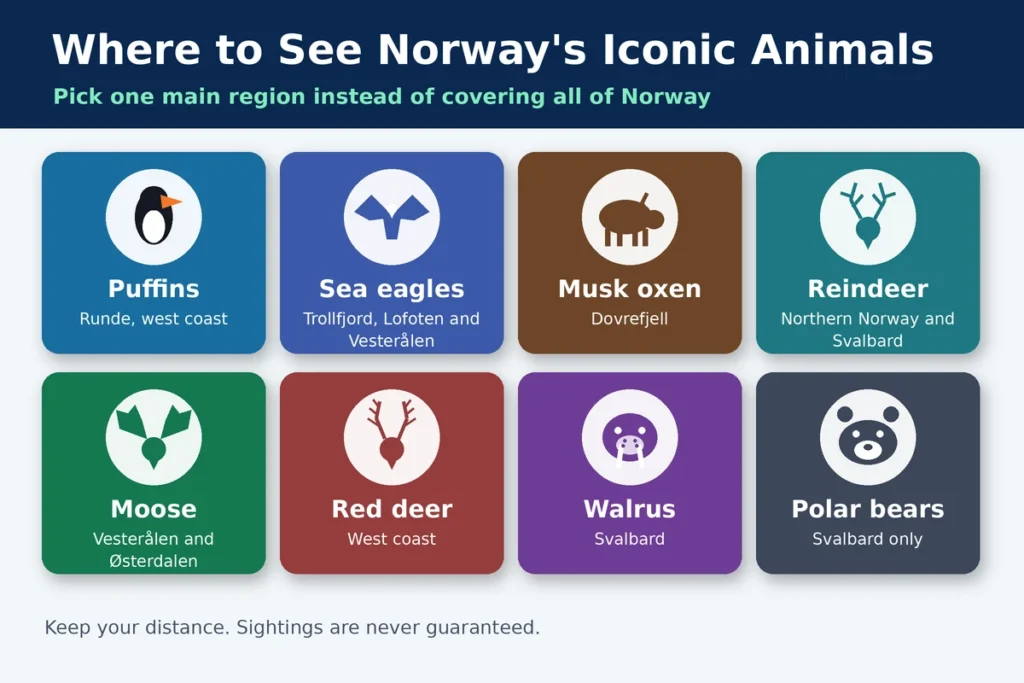
Norwegian fjords provide habitats for seabirds, seals, porpoises, and visiting whales. Their steep cliffs and cold waters create varied environments. Boat trips offer a useful way to explore these habitats without hiking long distances.
The species you see will depend on the location and season. Northern fjords may attract orcas and humpback whales when herring gathers there. Other areas offer seabird colonies and coastal landscapes.
Wildlife in Norway in Summer
Summer brings long daylight hours and easier access to many trails and coastal destinations. It is a popular season for puffin watching, hiking, and wildlife photography. You may also see reindeer, moose, sea eagles, and Arctic foxes.
Summer does not guarantee animal sightings. Some species move to different feeding or breeding areas throughout the year. Plan around your target species and check local updates before travelling.
Wildlife in Southern Norway
Southern Norway offers forests, coastal habitats, wetlands, and mountain landscapes. You may encounter moose, red deer, beavers, foxes, and many bird species. Runde, on the western coast, is also known for its seabird cliffs.
The best experience often comes from slowing down and exploring local nature areas. Visit protected sites responsibly and follow seasonal access rules. A regional wildlife guide can help you identify species and find suitable trails.
Wildlife in Sweden
Sweden shares several wildlife species with Norway because the countries have connected northern landscapes. Moose, reindeer, brown bears, lynx, and wolves occur in both countries, although their distribution differs. Sweden is another option for travellers interested in Nordic wildlife.
If you have more time, compare national parks and guided tours on both sides of the border. Check current wildlife guidance before travelling, as sightings and access vary by region.
Wildlife in Norway for Kids
Norway is a great place for children to learn about wildlife. They can look for seabirds, watch reindeer from a safe distance, or visit a nature centre. Choose short walks and family-friendly guided activities.
Teach children not to feed or touch wild animals. Bring binoculars, a wildlife guidebook, and warm clothing. Make the trip about observing nature rather than getting close to animals.
Responsible Wildlife Watching in Norway
Responsible wildlife watching protects both animals and visitors. Keep your distance, follow marked trails, and never feed wild animals. Use binoculars or a zoom lens instead of moving closer for photographs.
On Svalbard, polar bear safety requires special planning. Do not leave settlements without understanding current rules and arranging appropriate guidance or protection. Check official advice before any remote expedition.
Wildlife Itineraries for Different Travellers
The best itinerary depends on the animals you most want to see. Choose one main region rather than trying to cover all of Norway in a few days. Weather and wildlife movements can change your plans.
Best for Whale Lovers
Spend several days around Andenes or plan a winter trip from Tromsø toward Skjervøy. Check the season for your target species and leave time for changing weather.
Best for Birdwatchers
Visit Runde during the seabird season or explore the Varanger Peninsula in the northeast. Bring binoculars and check local birdwatching information before heading out.
Best for Arctic Wildlife
Consider a guided Svalbard expedition. Research polar bear safety, landing rules, and travel insurance before booking. Never plan an independent approach to a polar bear.
Best for Large Mammals
Visit Dovrefjell with a qualified musk ox guide. You can also explore forested regions where moose and red deer live. Always follow distance rules.
Ultimate Norwegian Wildlife Road Trip
Start in Oslo and travel north through forest and mountain regions. Continue toward the western fjords, then explore Vesterålen or Lofoten. If you have enough time, finish with a birdwatching trip to Varanger. Use a map to check distances and transport options before choosing your route.
Final Words
Wildlife in Norway offers many experiences, from watching whales in northern waters to spotting seabirds on coastal cliffs. You can also explore mountain habitats and search for reindeer, moose, and Arctic foxes.
Choose the right season for your interests and book responsible tours when needed. Keep your distance from wild animals and respect their habitats. With careful planning, you can enjoy Norway’s wildlife while helping protect it for future visitors.