Australian Slang: 125 Words and Phrases to Know in 2026
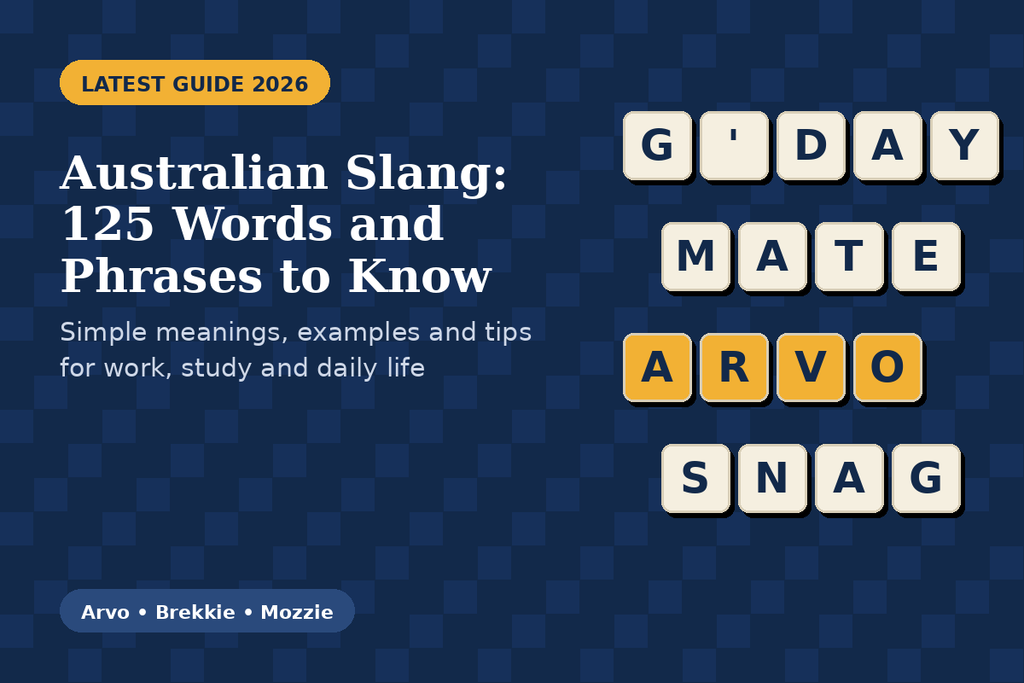
Australian Slang English has a personality of its own. People shorten words, use playful expressions, and often call each other “mate.” You may hear these words at work, in shops, at university, or while chatting with friends.
This guide explains 125 common expressions in simple English. You’ll learn what they mean, how to use them, and which ones to avoid in formal situations.
125 Australian Slang Words and Phrases
Many Australian expressions shorten longer words. Others come from local culture, work, sport, and everyday life. Here are useful terms to learn first.
Everyday Australian Slang
| No. | Slang | Meaning |
| 1 | Aussie | An Australian person or something from Australia |
| 2 | G’day | Hello |
| 3 | Mate | Friend or person |
| 4 | How ya going? | How are you? |
| 5 | No worries | No problem; you’re welcome |
| 6 | Arvo | Afternoon |
| 7 | Brekkie | Breakfast |
| 8 | Cuppa | A cup of tea or coffee |
| 9 | Maccas | McDonald’s |
| 10 | Servo | Service station or petrol station |
| 11 | Bottle-o | Bottle shop or liquor store |
| 12 | Uni | University |
| 13 | Rego | Vehicle registration |
| 14 | Tradie | Tradesperson |
| 15 | Bloke | Man or guy |
| 16 | Sheila | Woman; an older-fashioned term that may sound dated |
| 17 | Rellie | Relative |
| 18 | Flatmate | Person who shares your home |
| 19 | Sunnies | Sunglasses |
| 20 | Brolly | Umbrella |
| 21 | Mozzie | Mosquito |
| 22 | Aussie battler | An ordinary person working hard to get by |
| 23 | Heaps | A lot |
| 24 | Reckon | Think or believe |
| 25 | Defo | Definitely |
Food, Drinks, and Shopping
| No. | Slang | Meaning |
| 26 | Barbie | Barbecue |
| 27 | Snag | Sausage |
| 28 | Sanga | Sandwich |
| 29 | Bikkie | Biscuit or cookie |
| 30 | Choccy | Chocolate |
| 31 | Avo | Avocado |
| 32 | Chook | Chicken |
| 33 | Lollies | Sweets or candy |
| 34 | Esky | Portable cooler or icebox |
| 35 | Bottle shop | Shop selling alcoholic drinks |
| 36 | Brekky run | A quick trip to get breakfast |
| 37 | Takeaway | Food prepared to eat elsewhere |
| 38 | Munchies | A strong desire for a snack |
| 39 | Flat white | Espresso coffee with steamed milk |
| 40 | My shout | It’s my turn to pay |
| 41 | Go halves | Split the cost equally |
| 42 | Exy | Expensive |
| 43 | Cheap as chips | Very cheap |
| 44 | Hard yakka | Hard work |
| 45 | Chuck in | Contribute something, often money or effort |
Common Australian Expressions
| No. | Expression | Meaning |
| 46 | Fair dinkum | Genuine, honest, or true |
| 47 | She’ll be right | It will probably be okay |
| 48 | Good on ya | Well done |
| 49 | Too easy | No problem; that’s simple |
| 50 | You beauty! | An excited reaction to good news |
| 51 | No dramas | No problem |
| 52 | Give us a bell | Call me |
| 53 | Have a squiz | Take a look |
| 54 | Chuck a sickie | Take a sick day, sometimes dishonestly |
| 55 | Rack off | Go away; can sound rude |
| 56 | Pull your head in | Stop behaving badly or interfering |
| 57 | Have a crack | Give something a try |
| 58 | Give it a burl | Try something |
| 59 | Hang on a tick | Wait a moment |
| 60 | Good as gold | Fine, reliable, or all sorted |
| 61 | Flat out | Extremely busy |
| 62 | Chock-a-block | Very full or crowded |
| 63 | Buckley’s chance | Almost no chance |
| 64 | A few roos loose | Acting foolishly; an informal insult |
| 65 | Bob’s your uncle | There you go; it’s done |
Work and Study Slang
| No. | Slang | Meaning |
| 66 | Smoko | A short work break |
| 67 | Doco | Documentary |
| 68 | Journo | Journalist |
| 69 | Ambo | Ambulance or ambulance worker, depending on context |
| 70 | Comp o | Compensation payment, often shortened to “compo” |
| 71 | Vego | Vegetarian |
| 72 | Sickie | A day off taken as sick leave |
| 73 | Whinge | Complain repeatedly |
| 74 | Knackered | Extremely tired |
| 75 | Devo | Devastated or very upset |
| 76 | Stoked | Very pleased or excited |
| 77 | Spewin’ | Very disappointed or angry |
| 78 | Dodgy | Suspicious, unreliable, or poor quality |
| 79 | Suss | Investigate or view something with suspicion |
| 80 | Sorted | Taken care of |
| 81 | Onya | Short for “on you,” as in “good onya” |
| 82 | Ta | Thanks |
| 83 | Keen as | Very interested or eager |
| 84 | Hard yakka day | A day of difficult work |
| 85 | Play it by ear | Decide later based on the situation |
Australian Slang for Places and Things
| No. | Slang | Meaning |
| 86 | The bush | Rural or wooded country |
| 87 | The outback | Remote inland areas of Australia |
| 88 | Ute | Utility vehicle or pickup truck |
| 89 | Boot | The trunk of a car |
| 90 | Bonnet | The hood of a car |
| 91 | Footpath | Sidewalk |
| 92 | Trolley | Shopping cart |
| 93 | Dunny | Toilet; very informal |
| 94 | Doona | Quilt or duvet |
| 95 | Trackies | Tracksuit trousers or tracksuit clothing |
| 96 | Flanno | Flannelette shirt |
| 97 | Thongs | Flip-flops or sandals |
| 98 | Bathers | Swimsuit |
| 99 | Servo pie | A pie bought at a service station |
| 100 | Woolies | Woolworths supermarket |
More Expressions to Recognise
| No. | Slang | Meaning |
| 101 | Straya | A playful pronunciation of Australia |
| 102 | Ocker | A person with a broad, stereotypical Australian style |
| 103 | Tall poppy | A successful person who attracts criticism |
| 104 | Tall poppy syndrome | The habit of criticising people for standing out |
| 105 | Mad as a cut snake | Extremely angry or acting wildly |
| 106 | Mad keen | Very enthusiastic |
| 107 | Crack up | Laugh a lot, or something very funny |
| 108 | Take the piss | Tease someone or make fun of a situation |
| 109 | Pulling your leg | Joking with someone |
| 110 | A ripper | Something excellent |
| 111 | Grouse | Great or excellent; more regional or old-fashioned |
| 112 | Bonza | Excellent; old-fashioned but recognisable |
| 113 | Ripper of a day | A really good day |
| 114 | Crook | Sick, or sometimes dishonest |
| 115 | Buggered | Exhausted or broken; can be mildly vulgar |
| 116 | Bloody oath | Strong agreement; informal and mildly profane |
| 117 | Bloody good | Very good |
| 118 | Fair go | A reasonable chance or fair treatment |
| 119 | The whole shebang | Everything |
| 120 | Up the creek | In trouble or in a difficult situation |
| 121 | Away with the pixies | Distracted or not paying attention |
| 122 | Make a blue | Have an argument |
| 123 | Carry on | Make a fuss or continue behaving noisily |
| 124 | Yewy | A U-turn |
| 125 | Woop Woop | A joking name for a remote place |
These terms vary in popularity. Some are common in daily conversation, while others are regional, older, or mainly used for humour.
How to Speak Australian English
You don’t need to copy an accent to understand Australians. Start by learning common expressions and listening to how locals use them.
Australians often shorten words. For example, “afternoon” becomes “arvo,” and “breakfast” becomes “brekkie.” Many words end in “-o” or “-ie” after shortening. This pattern is common, but it doesn’t apply to every word.
Try these simple examples:
- “G’day, mate. How ya going?”
- “Let’s grab a cuppa this arvo.”
- “No worries. I’ll give you a bell later.”
- “I’m knackered after work.”
- “That was a ripper of a game!”
Listen to the whole sentence instead of focusing on one word. Tone and context often tell you whether someone is joking, complaining, or being serious.
Australian Phrases for Daily Life
A few useful expressions can help you feel more comfortable when visiting or living in Australia.
| Phrase | Example |
| No worries | “Thanks for helping.” — “No worries!” |
| How ya going? | “Hey, how ya going?” |
| Good on ya | “You passed your exam? Good on ya!” |
| Have a squiz | “Have a squiz at this photo.” |
| She’ll be right | “Don’t stress. She’ll be right.” |
| Give us a bell | “Give us a bell when you arrive.” |
| My shout | “Coffee’s my shout today.” |
| Too easy | “Can you send that file?” — “Too easy.” |
These phrases are informal. They work well with friends, classmates, and familiar colleagues. In formal emails or job interviews, standard English is usually a safer choice.
Slang in the Workplace
Australian workplaces can sound relaxed. Co-workers may use humour, nicknames, and casual language to build relationships. However, workplace culture differs by industry and team.
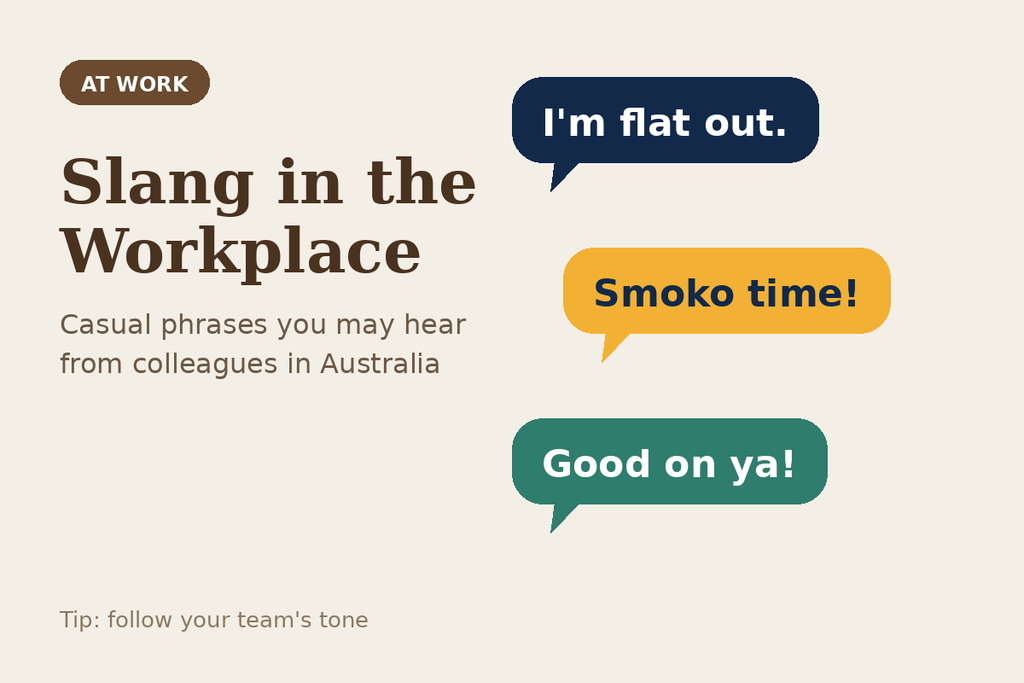
Here are a few expressions you might hear:
- “I’m flat out.” — I’m very busy.
- “Let’s have a squiz.” — Let’s take a look.
- “Good on ya.” — Well done.
- “Hard yakka.” — Difficult work.
- “No worries.” — That’s fine.
Avoid copying swear words just because colleagues use them. You may not know how comfortable others feel about that language. When you’re new to a workplace, start politely and follow the team’s tone.
Why Australian Slang Matters
Learning local expressions can make everyday conversations easier. It can also help you understand jokes, instructions, and informal messages.
Cultural Understanding
Slang offers a small window into local culture. Expressions such as “fair go” and “good on ya” can reflect ideas about fairness, encouragement, and friendliness.
Everyday Communication
You may hear slang in shops, on public transport, or while talking with neighbours. Recognising common words helps you follow the conversation without asking for every definition.
Work and Study
Students and international workers may encounter informal English from their first week. Learning common expressions can make group discussions and small talk easier.
You can always ask someone to explain a word. Most people will understand that local slang can be confusing to newcomers.
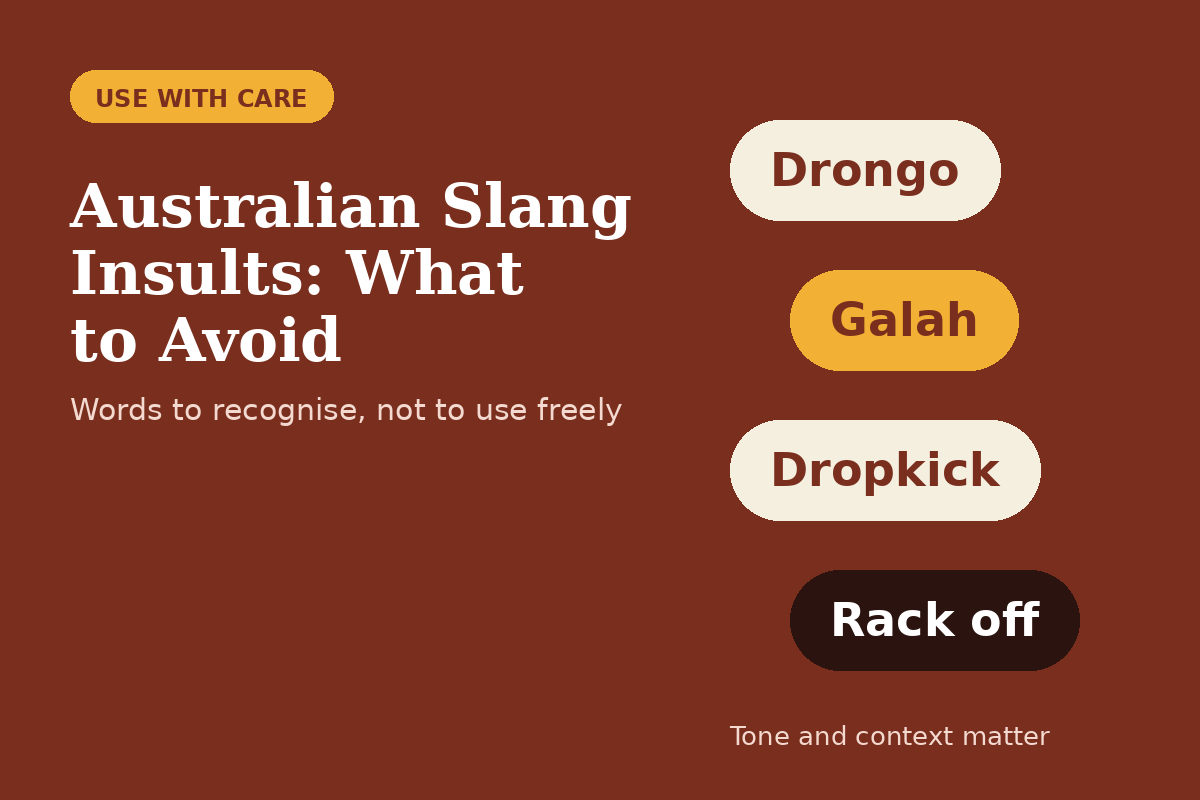
Australian Slang Insults: What to Avoid
Some slang words are harmless between close friends but rude when used with strangers. Tone, relationship, and context matter.
Here are a few expressions to recognise rather than use freely:
| Expression | Meaning or tone |
| Drongo | A foolish person |
| Galah | A silly or foolish person |
| Dropkick | An insulting term for someone considered useless |
| Grub | A nasty or unpleasant person |
| Gronk | An insult for someone acting foolishly |
| Rack off | A rude way to tell someone to go away |
| Take a hike | Tell someone to leave; less distinctly Australian |
| Bugger off | A blunt and sometimes offensive way to tell someone to leave |
These are examples of insults, not friendly greetings. Some people use them jokingly with close friends. They can still cause offence, especially when you don’t know the person well.
Avoid insults in professional settings. If someone uses a term you don’t understand, ask what they mean before responding.
Australian Slang for Girls and Compliments
The phrase Australian slang for girl often leads people to the word “sheila.” It has a long history in Australian English, but it can sound old-fashioned or stereotypical today.
“Woman,” “girl,” and “mate” are usually safer choices. Use “girl” only when it suits the person’s age and the context. Don’t assume everyone likes being called by a slang nickname.
Friendly Australian Slang Compliments
You can praise someone without using exaggerated language. These expressions are casual and generally positive:
- “Good on ya!” — Well done.
- “You’re a legend.” — You’re great or very helpful.
- “You’re a ripper.” — You’re excellent; this is informal.
- “That was bonza.” — That was great; somewhat old-fashioned.
- “You’re a top bloke.” — You’re a good guy; informal and gender-specific.
- “You’re a champion.” — You’re helpful or impressive.
These Australian slang compliments work best when your tone is genuine. For a professional setting, “Great work” or “Thanks for your help” may sound more natural.
Why Australian Slang Is Funny
Some expressions sound funny because they use unexpected words. Calling an afternoon “arvo” or a mosquito “mozzie” can seem unusual to someone learning English.
Australian slang is funny. It can also be confusing because the same phrase may sound friendly in one setting and rude in another. A word like “buggered” might mean exhausted, while “take the piss” can mean teasing someone.
Humour also depends on delivery. Don’t assume every Australian uses the same expressions or enjoys the same jokes.
Australian Slang on Reddit and Urban Dictionary
People often look up unfamiliar expressions in online discussions. Searching Australian slang on Reddit may show how individual users use a word in real conversations. However, a single comment doesn’t prove that an expression is common across Australia.
Australian slang urban dictionary searches can also reveal informal meanings and jokes. User-submitted definitions may be exaggerated, outdated, or incorrect. Compare them with university language guides or established Australian dictionaries before using an unfamiliar term.
For reliable starting points, try these resources:
- Charles Sturt University: Aussie slang words and phrases
- ABC Education: Learn English—Aussie slang
- University of Western Australia: Speaking like a local
A Quick Guide to Using Australian Slang
You can learn slang through everyday conversations. Start with expressions that are easy to understand and unlikely to offend anyone.
- Listen first: Notice when people use a phrase and how they say it.
- Start with common words: Try “no worries,” “arvo,” and “mate.”
- Watch the setting: Casual slang may not suit a formal meeting.
- Ask questions: It’s fine to ask what an expression means.
- Don’t force it: Natural communication matters more than sounding like a local.
You don’t need to memorise all 125 expressions. Learn a few at a time and practise them when the situation feels right.
Conclusion
Australian slang can make everyday English more colourful and relaxed. Common expressions like “G’day,” “no worries,” and “brekkie” are useful starting points.
Remember that slang changes across regions, generations, and social groups. Listen carefully, use friendly expressions first, and avoid rude terms until you understand their meaning and tone.
FAQs
How Do Australians Say “I Love You”?
Australians usually say “I love you,” just like other English speakers. Close couples may also use terms such as “love,” “darling,” or “babe.”
How Do Aussies Say “Cool”?
They may say “cool,” “awesome,” “ripper,” or “bonza,” depending on the person and situation.
What Is the Most Aussie Thing to Say?
“G’day, mate” is one of the best-known Australian greetings, though not everyone uses it regularly.
What Do Aussies Call $20 in Slang?
A $20 note has sometimes been called a “lobster” because of its red colour, but the nickname isn’t universal. “Twenty-dollar note” is the clearest everyday term.