
All You Need to Know Before Visiting Basilica di San Vitale
The Basilica di San Vitale is one of the most famous historic sites in Ravenna, Italy. It is known for its golden mosaics, unusual design, and rich Byzantine history. The church offers a close look at early Christian art and architecture.
Built during the sixth century, this landmark remains one of Ravenna’s most important attractions. It also forms part of a UNESCO World Heritage Site. Whether you love history, art, or architecture, this guide will help you plan your visit.
A Brief History of Basilica di San Vitale
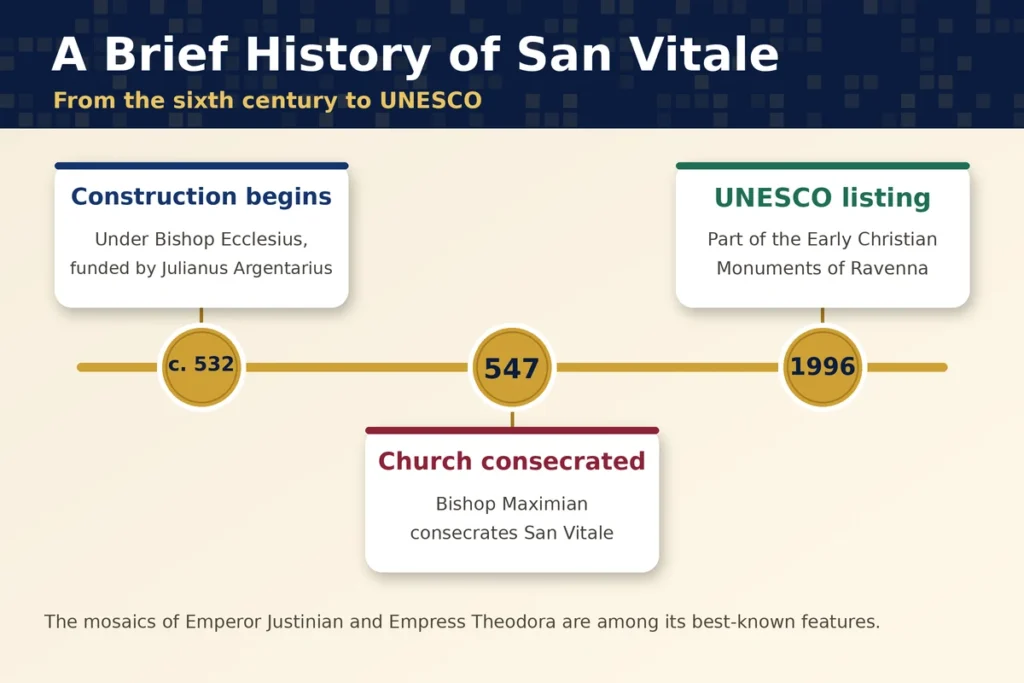
Construction of the basilica began around 532 under Bishop Ecclesius. A wealthy banker named Julianus Argentarius helped fund the project. Bishop Maximian consecrated the church in 547.
At that time, Ravenna was an important political and religious center. The Byzantine Empire influenced the city’s art, culture, and architecture. San Vitale reflects this influence through its mosaics and distinctive building design.
The church also represents a meeting point between Roman and Byzantine artistic traditions. Its decorations show religious figures alongside powerful rulers.
At the Origins of the Basilica
The basilica was built during a period of major change in Italy. Ravenna had served as the capital of the Western Roman Empire before becoming an important center under Ostrogothic and Byzantine rule.
Its design drew on earlier Roman building traditions while introducing features associated with Eastern Christian architecture. The result was a church with a central space rather than the long layout found in many traditional basilicas.
The project also required skilled builders and mosaic artists. Their work created a monument that combined engineering, religious symbolism, and artistic detail.
San Vitale during the Centuries: A Synopsis
San Vitale has changed over time, but its main historical character remains visible. The building has undergone repairs and restoration as its materials aged. Later decorative work also changed parts of the interior.
The mosaics remain its most celebrated feature. They show biblical scenes, saints, and important figures from the Byzantine period. Emperor Justinian and Empress Theodora appear in famous mosaic panels that reveal the political and religious importance of the church.
The basilica became part of Ravenna’s UNESCO World Heritage listing in 1996. Today, visitors can explore it as both a place of worship and a major cultural monument.
Monitoring of the Displacements in the Basilica
Historic buildings can develop cracks and movement as their materials age. San Vitale has been studied by researchers who examined its structural condition. Their work explored cracking, deformation, ground settlement, and seasonal temperature changes.
Researchers used structural models and measurements to better understand how the building behaves. Monitoring helps experts study changes over time and assess possible risks to the historic structure.
This work matters because conservation requires more than repairing visible damage. Experts must understand why movement occurs before choosing suitable restoration methods. Such studies help protect the basilica for future generations.
Why Visit This UNESCO World Heritage Site
San Vitale is worth visiting for its history, art, and unusual design. It also sits close to other important monuments in Ravenna. You can combine your visit with the Mausoleum of Galla Placidia and other nearby historic sites.
The basilica is part of the UNESCO-listed Early Christian Monuments of Ravenna. The group includes eight buildings that preserve outstanding examples of early Christian art and architecture. Their mosaics show a blend of Roman, Christian, and Eastern influences.
The Stunning Mosaics
The San Vitale mosaics are the main reason many visitors come here. They use bright colors, detailed figures, and gold backgrounds to create a striking visual effect.
Look closely at the panels featuring Emperor Justinian and Empress Theodora. These images combine religious meaning with symbols of imperial power. Other mosaics show biblical scenes and figures connected with Christian tradition.
The light inside the church makes the colors and surfaces appear different from various angles. Take your time when viewing the apse and presbytery. These areas contain some of the basilica’s most remarkable artwork.
Architectural Marvel
The basilica has an unusual octagonal design. Two main octagonal sections create a layered exterior. Inside, a central space rises beneath a dome and is surrounded by galleries and passages.
This distinctive San Vitale architecture combines Roman building methods with Byzantine ideas. The design creates a sense of height and openness. It also directs attention toward the sanctuary and its colorful decorations.
The building’s layout differs from the long rectangular plan of many churches. If you enjoy historic buildings, look at how the columns, arches, galleries, and central dome work together.
A UNESCO World Heritage Site
UNESCO added San Vitale to the Early Christian Monuments of Ravenna listing in 1996. The designation recognizes the artistic and historical value of the city’s surviving monuments.
The site offers evidence of cultural exchange between the Eastern and Western worlds. Its art helps explain how Christian imagery developed during a major period of European history.
A visit also gives you a chance to explore Ravenna beyond its famous mosaics. The surrounding historic center contains other churches, museums, and architectural landmarks.
How to Get Basilica di San Vitale Tickets
You can buy tickets online or at the official monument ticket offices, subject to availability. A combined ticket is often a useful option because it includes entry to more than one historic site.
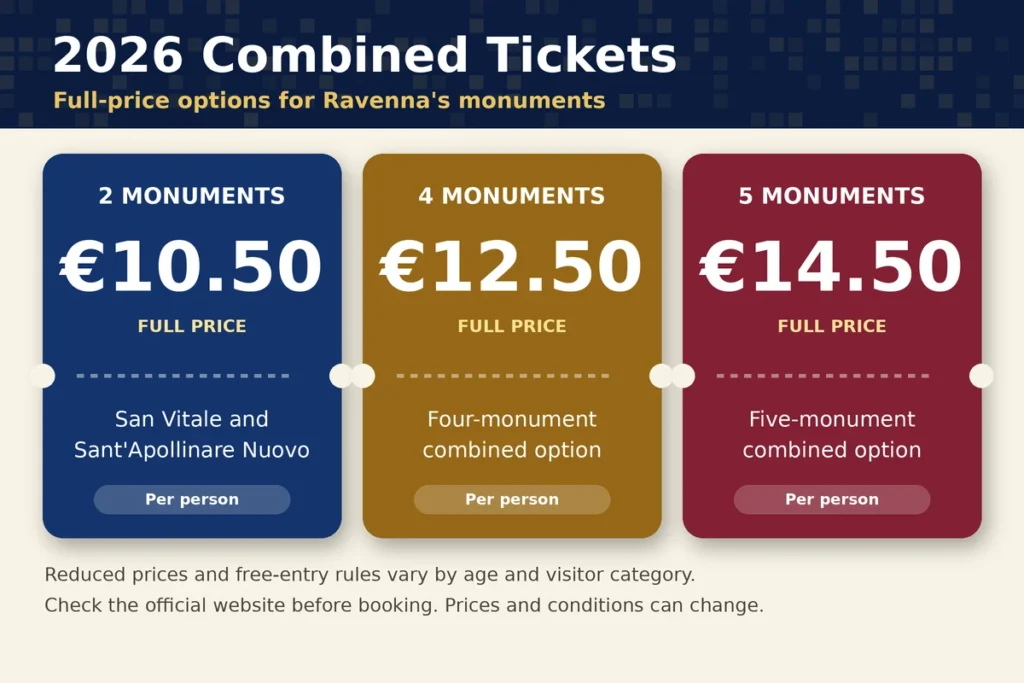
According to Ravenna’s tourism information, the 2026 two-monument ticket for San Vitale and Sant’Apollinare Nuovo costs €10.50 at full price. A four-monument option costs €12.50, while the five-monument option costs €14.50.
Reduced prices and free-entry rules vary by age and visitor category. Check the official website before booking because prices and conditions can change.
Tips for Visiting Basilica di San Vitale
Plan to spend enough time looking at the mosaics instead of rushing through the building. Visiting earlier in the day may also help you enjoy the space before it becomes busier.
Keep these practical tips in mind:
- Check opening hours: Confirm the current schedule before leaving your hotel.
- Dress respectfully: This is a church, so choose clothing suitable for a religious site.
- Check photography rules: Follow the signs and staff instructions inside.
- Buy a combined ticket: Consider a multi-monument ticket if you plan to visit other UNESCO sites.
- Explore nearby landmarks: The Mausoleum of Galla Placidia is close to the basilica.
- Allow time for details: Look at the mosaic panels, marble surfaces, columns, and central dome.
You may also want to look at a San Vitale plan before arriving. A floor plan can help you understand the central octagonal space, surrounding passages, galleries, and sanctuary. Compare it with the actual building to see how the design guides visitors toward the altar.
For trip planning, search for Basilica of San Vitale photos from reliable tourism sources. Images can help you recognize the exterior, mosaic panels, and interior layout before your visit.
Stay at Exclusive ApartHotel La Reunion Near Basilica di San Vitale
If you want to stay in Ravenna’s historic center, Exclusive ApartHotel La Reunion is one accommodation option to consider. It offers apartment-style suites with hotel comforts. Its central location also makes it useful for exploring the city’s historic attractions.
The property is located at Via Corrado Ricci 29 in Ravenna. San Vitale is within the historic center, so check the walking route and distance when planning your stay. You can compare room types and current rates on the property’s official website.
Why Choose Exclusive ApartHotel La Reunion
La Reunion offers suites with living areas and kitchenettes. The listed facilities include Wi-Fi, private bathrooms, and air conditioning or heating. Some services and room features may depend on the suite you book.
The property does not have its own garage. It offers information about local parking arrangements and a municipal car pass for eligible areas. Ask the hotel about current prices, access rules, and availability before arrival.
Staying in the center can make it easier to visit several monuments on foot. It can also reduce the need to move your car between attractions. Compare the location, room facilities, cancellation policy, and total price before confirming a reservation.
Conclusion
The Basilica di San Vitale is one of Ravenna’s most valuable historic landmarks. Its golden mosaics, octagonal design, and Byzantine heritage make it a memorable place to visit.
Check the latest ticket information before your trip. If you have time, explore the nearby UNESCO monuments as well. Together, they offer a deeper look at Ravenna’s artistic and religious history.
People Also Ask About San Vitale
What Is San Vitale Famous For?
San Vitale is famous for its sixth-century Byzantine mosaics, including the celebrated panels of Emperor Justinian and Empress Theodora.
Why Is San Vitale Octagonal?
Its octagonal design creates a central worship space surrounded by galleries and reflects architectural ideas used in early Byzantine churches.
Is San Vitale a Catholic Church?
Yes, the Basilica of San Vitale is a Catholic church in Ravenna, Italy.
What Is Ravenna, Italy, Most Famous For?
Ravenna is best known for its early Christian and Byzantine mosaics, historic churches, and UNESCO World Heritage monuments.