
15 Famous Landmarks in History Around the World You Must Visit

Famous landmarks connect us with the past and show what people can achieve. Some are thousands of years old. Others represent modern engineering and design.
From the Eiffel Tower in France to Machu Picchu in Peru, these destinations attract travelers from across the globe. Each has a unique story, cultural value, and architectural style.
This guide explores 15 famous landmarks across different continents. You’ll discover their history, location, and reasons to visit. You’ll also find practical tips to help you plan a memorable trip.
Why Are Famous Landmarks Important?
Landmarks help preserve the history and identity of a place. They may commemorate important events, represent religious beliefs, or demonstrate remarkable engineering skills.
Many landmarks also support local tourism. Visitors explore nearby museums, restaurants, historic districts, and cultural attractions. This creates opportunities for local businesses and communities.
Some landmarks have UNESCO World Heritage status because of their cultural or natural importance. However, fame alone does not guarantee this recognition. Every site has its own history and significance.
15 Famous Landmarks in the World
There is no single official ranking of the world’s most famous landmarks. The following selection includes historic monuments, modern structures, and archaeological sites.
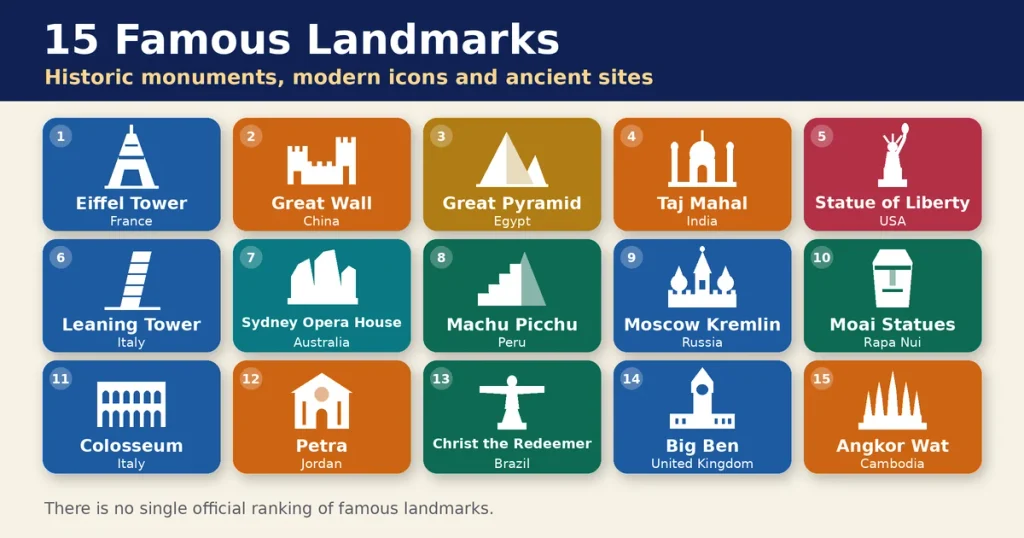
1. Eiffel Tower, France
The Eiffel Tower stands in Paris and is one of France’s most recognizable symbols. It was built for the 1889 World’s Fair to celebrate the centenary of the French Revolution.
Engineer Gustave Eiffel’s company led the construction. The iron structure demonstrated the possibilities of modern engineering during the industrial era.
Today, visitors can enjoy panoramic views of Paris from its observation levels. The tower is especially popular around sunset and after dark. Check official visitor information before planning your visit.
2. Great Wall of China, China
The Great Wall stretches across northern China through mountains, valleys, and historic landscapes. Different Chinese dynasties built and expanded sections over many centuries.
Around 220 BCE, the Qin dynasty connected earlier fortifications into a wider defense system. Later rulers continued construction, including the Ming dynasty.
The historic wall system extends for more than 20,000 kilometers. Visitors can explore restored sections near Beijing and learn about China’s military history. The wall was added to the UNESCO World Heritage List in 1987. Explore its history.
3. Great Pyramid of Giza, Egypt
The Great Pyramid of Giza is among the most remarkable surviving monuments of ancient Egypt. It was built as a tomb for Pharaoh Khufu during the Old Kingdom.
Its construction dates to approximately the 26th century BCE. The enormous stone structure reflects the planning and technical knowledge of ancient Egyptian builders.
The pyramid forms part of the Giza pyramid complex near Cairo. Visitors can explore the surrounding archaeological landscape and learn about ancient Egyptian burial traditions. It remains one of the most significant examples of early monumental architecture.
4. Taj Mahal, India
The Taj Mahal stands in Agra, India. Mughal emperor Shah Jahan commissioned it in memory of his wife, Mumtaz Mahal.
Construction began in 1632, and the main mausoleum was completed in 1648. The wider complex includes gardens, a mosque, a guesthouse, and monumental gateways.
Its white marble, balanced design, and detailed stone inlay make it a masterpiece of Mughal architecture. The Taj Mahal became a UNESCO World Heritage Site in 1983. Early morning visits can offer beautiful light and a calmer atmosphere. Read more about the monument.
5. Statue of Liberty, United States
The Statue of Liberty stands on Liberty Island in New York Harbor. France gave it to the United States as a symbol of friendship.
The statue was dedicated in 1886. It later became an enduring symbol of freedom and a welcoming sight for immigrants arriving in America.
Visitors can take a ferry to Liberty Island and explore exhibits about the monument. The nearby views of Manhattan also make the trip worthwhile. Check ferry schedules and access rules before visiting.
6. Leaning Tower of Pisa, Italy
The Leaning Tower of Pisa is famous for its noticeable tilt. It stands in Piazza del Duomo, a historic complex that also includes a cathedral and baptistery.
Construction began in the 12th century. The tower started leaning because the ground beneath its foundations was too soft to support the structure evenly.
Engineers later completed major stabilization work to protect it. Today, visitors can admire its white stone exterior and explore the surrounding historic square. Booking ahead is advisable if you want to climb the tower.
7. Sydney Opera House, Australia
The Sydney Opera House sits beside Sydney Harbour. Its distinctive roof resembles a series of sails and makes it one of Australia’s best-known landmarks.
Danish architect Jørn Utzon designed the building after winning an international competition. The venue officially opened in 1973.
Today, it hosts concerts, theater productions, and other cultural events. You can admire the architecture from the waterfront or join a guided tour. Check the official schedule if you want to attend a performance.
8. Machu Picchu, Peru
Machu Picchu is an archaeological site in Peru’s Andes Mountains. The Inca civilization built it during the 15th century.
The site contains stone buildings, terraces, pathways, and carefully planned spaces. Its location on a mountain ridge creates a dramatic setting.
Historians continue to study its original purpose. It likely served several royal, religious, and ceremonial functions. Visitors should arrange entry in advance and check permitted routes. The high elevation and mountain terrain also require careful planning. Explore the UNESCO site.
9. Moscow Kremlin, Russia
The Moscow Kremlin is a historic fortified complex in the Russian capital. Its walls, towers, palaces, and cathedrals reflect different periods of Russian history.
The complex has played an important role in the country’s political and cultural life. It is not a single building but a group of structures within fortified walls.
Nearby Red Square adds to the area’s historical importance. Travelers should check current visitor arrangements and official travel guidance before making plans.
10. Moai Statues, Rapa Nui
The moai are monumental stone figures created by the Rapa Nui people on Easter Island, which belongs to Chile. Many stand on stone platforms known as ahu.
The statues represent an important part of Rapa Nui’s ancestral traditions. Their scale and carving techniques continue to interest researchers and visitors.
The island is remote, so travelers should plan transportation carefully. Visitors must also respect local heritage rules and avoid climbing on protected statues.
11. Colosseum, Italy
The Colosseum is one of the most recognizable remains of the Roman Empire. It stands in the center of Rome and dates to the first century CE.
The enormous amphitheater hosted public spectacles, including gladiatorial contests. Its entrances and passageways helped manage large crowds.
Today, visitors can explore parts of the structure and learn about Roman entertainment and engineering. The nearby Roman Forum offers more insight into the city’s ancient political and social life.
12. Petra, Jordan
Petra is an ancient archaeological city in southern Jordan. It is famous for buildings and tombs carved into rose-colored sandstone cliffs.
Petra flourished under the Nabataeans and developed as an important center along regional trade routes. The Treasury is its best-known facade, but the site contains many other structures.
Visitors can explore tombs, temples, pathways, and mountain scenery. Wear comfortable shoes and allow enough time to walk beyond the main entrance.
13. Christ the Redeemer, Brazil
Christ the Redeemer stands atop Mount Corcovado overlooking Rio de Janeiro. The statue depicts Jesus Christ with outstretched arms.
It was inaugurated in 1931 and became one of Brazil’s best-known symbols. The viewpoint offers impressive views of the city, surrounding mountains, and coastline.
Weather can affect visibility, so check conditions before your visit. Use approved transport options and allow extra time during busy periods.
14. Big Ben and the Palace of Westminster, United Kingdom
The Palace of Westminster is home to the UK Parliament in London. Its distinctive Gothic Revival architecture makes it a major feature of the city’s skyline.
Many people use the name Big Ben for the entire clock tower. However, Big Ben is technically the name of the Great Bell inside Elizabeth Tower.
Visitors can admire the buildings from nearby public areas. Parliamentary tours may also be available on selected dates. Check official access information before planning a visit.
15. Angkor Wat, Cambodia
Angkor Wat is a vast temple complex near Siem Reap, Cambodia. It was built during the 12th century under the Khmer Empire.
The temple was originally dedicated to the Hindu god Vishnu. It later became an important Buddhist religious site.
Its towers, galleries, and detailed stone carvings reflect the achievements of Khmer architecture. Visitors should dress respectfully and follow rules at active religious areas. Famous Landmarks by Region
Exploring destinations by region can make travel planning easier. It also helps you compare different cultures and architectural traditions.
Famous landmarks in Europe
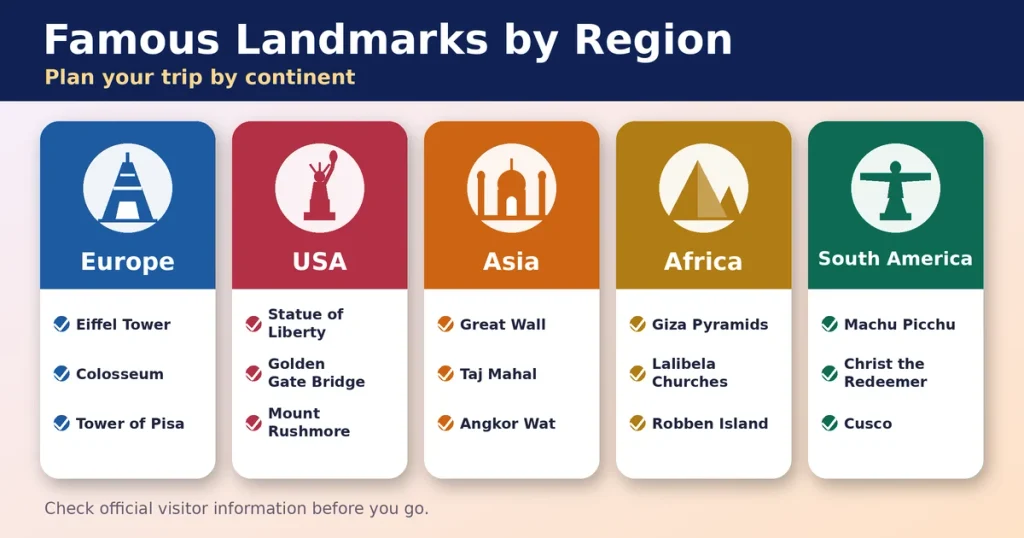
Europe combines ancient ruins with impressive modern structures. The Eiffel Tower, Colosseum, Leaning Tower of Pisa, and Palace of Westminster are popular examples.
You can visit several European landmarks during one trip. However, allow enough time for transport, tickets, and local exploration.
Famous landmarks in the USA
The Statue of Liberty is a major symbol of American history. Other notable sites include the Golden Gate Bridge in San Francisco, Mount Rushmore in South Dakota, and the Lincoln Memorial in Washington, D.C.
These destinations are spread across the country. Group your visits by region to reduce travel time and costs.
Famous landmarks in Asia
Asia offers historic temples, defensive structures, and remarkable architecture. The Great Wall of China, Taj Mahal, and Angkor Wat are among its best-known landmarks.
Each destination reflects a different historical and cultural tradition. Research local customs before visiting religious or sacred places.
Famous landmarks in Africa
Africa contains monuments that reflect ancient civilizations and more recent history. The Great Pyramid of Giza is one of the continent’s best-known historic sites.
Other important destinations include the rock-hewn churches of Lalibela in Ethiopia and Robben Island in South Africa. Each offers a different perspective on the region’s cultural heritage.
Famous landmarks in South America
Machu Picchu preserves an important legacy of the Inca civilization. Christ the Redeemer represents Rio de Janeiro’s cultural identity.
Travelers can also explore historic Cusco in Peru. Check elevation, transport options, and entry requirements before visiting mountain destinations.
How to Choose Landmarks for Your Next Trip
Start by considering your interests. History lovers may prefer the Great Pyramid of Giza or the Colosseum. Architecture fans might enjoy the Eiffel Tower or Sydney Opera House.
Next, consider your budget and available time. Some destinations require advance reservations, while others involve long walks or remote travel.
Check official visitor information before booking. Pay attention to opening hours, accessibility, local customs, and seasonal conditions.
Exploring More Landmarks Around the World
A list of 100 famous landmarks can provide inspiration for future trips. Include ancient monuments, religious sites, bridges, towers, and natural attractions to create a balanced travel list.
An A to Z guide can also help you discover places beyond the usual tourist favorites. You might begin with Angkor Wat and continue through destinations across different continents.
Some travel guides focus on 7 famous monuments of the world. These lists can be useful starting points, but there is no single official ranking of the world’s most important landmarks.
Finding and Using Landmark Pictures
Browsing Famous landmark pictures can help you choose destinations and plan your itinerary. Official tourism websites, heritage organizations, and national parks often provide reliable photographs and background information.
If you use images in a travel article, check their copyright and licensing terms. Never assume that an image is free to reuse simply because it appears in search results.
Add descriptive alt text to improve accessibility. For example, “Taj Mahal in Agra viewed across its reflecting pool” tells readers and search engines what the image shows.
Conclusion
Famous landmarks reveal the history, creativity, and beliefs of people around the world. From ancient pyramids to modern architectural icons, each destination offers something different.
Research your chosen sites before traveling. Respect local communities, follow conservation rules, and plan around entry requirements. These simple steps can help you enjoy a more meaningful travel experience.
Frequently Asked Questions
What is the most famous landmark in the world?
There is no universally accepted winner. The Eiffel Tower, Great Wall of China, Taj Mahal, and Statue of Liberty are widely recognized.
Which landmarks are best for history lovers?
The Great Pyramid of Giza, Colosseum, Petra, and Machu Picchu offer valuable insight into ancient civilizations.
Are famous landmarks always UNESCO World Heritage Sites?
No. UNESCO recognition depends on specific cultural or natural heritage criteria. Many well-known landmarks do not have this status.
How can I plan a landmark visit?
Check official tickets, opening hours, transportation, accessibility, and local rules before you travel.